Window Tint Laws in North Carolina: Legal Percentages for Cars, SUVs, and Trucks
SCHEDULE ONLINE
North Carolina window tint laws regulate how much light must pass through vehicle windows, where windshield film may be installed, and which vehicles qualify for darker rear glass. The rules also cover reflectivity, prohibited colors, medical permits, and roadside enforcement.
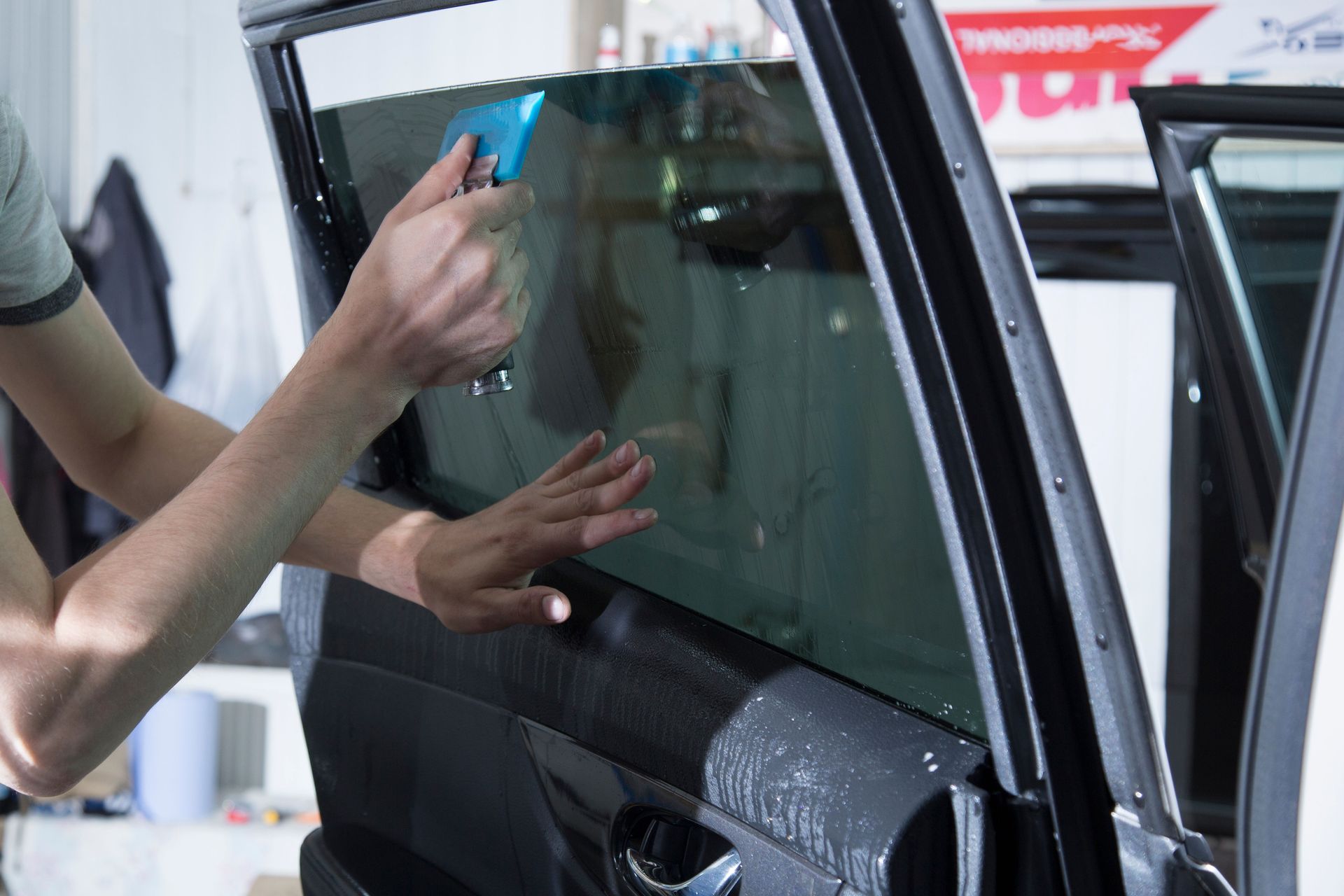
At Champion Window Tinting, drivers can compare film shades based on their vehicle’s factory glass, window position, and the finished Visible Light Transmission measurement.
What Tint Is Legal in North Carolina?
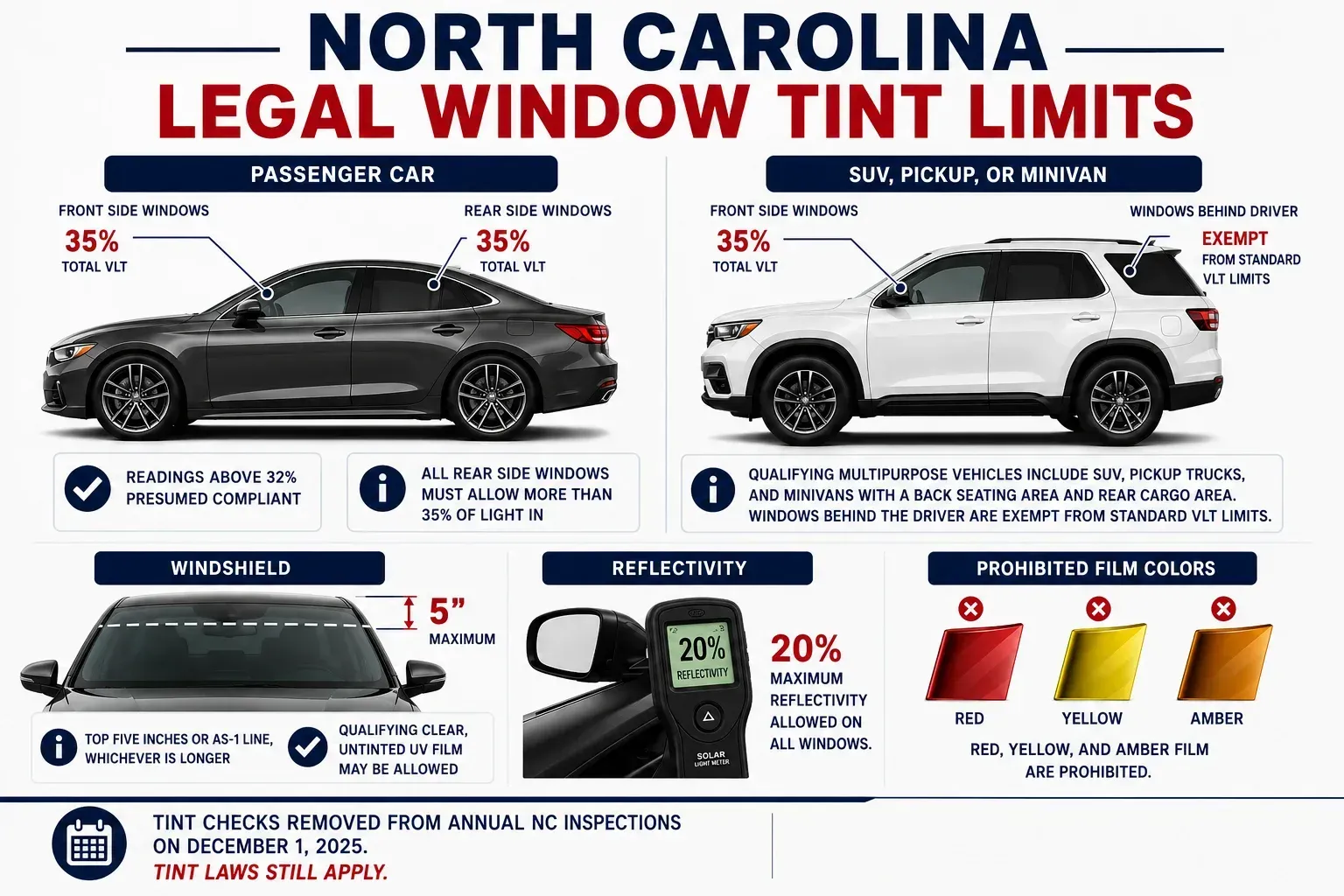
North Carolina generally requires regulated vehicle windows to have at least 35% total Visible Light Transmission, commonly shortened to VLT. A window measuring above 32% with an approved meter is conclusively presumed to meet the 35% requirement.
For passenger cars, the rule generally applies to the front side windows, rear side windows, and rear window. Qualifying SUVs, pickup trucks, and minivans may use darker film on windows positioned behind the driver.
Windshield film follows separate placement rules. Regular tinted film is limited to the top of the windshield, while qualifying clear and untinted UV film may cover a larger area if it does not obstruct the driver’s view.
Drivers comparing shades can review legal automotive window film options before choosing film based only on how it appears in photographs.
North Carolina Window Tint Limits at a Glance
| Window | Passenger Cars | SUVs, Trucks and Minivans |
|---|---|---|
| Windshield | Tint strip within the permitted upper area; qualifying clear UV film may cover the windshield | Same requirement |
| Front side windows | At least 35% total VLT; readings above 32% are presumed compliant | At least 35% total VLT; readings above 32% are presumed compliant |
| Rear side windows | At least 35% total VLT | VLT and reflectivity restrictions do not apply to qualifying windows behind the driver |
| Rear window | At least 35% total VLT | Generally exempt from the regular VLT and reflectivity limits when positioned behind the driver |
| Reflectivity | No more than 20% on regulated windows | No more than 20% on regulated windows |
| Prohibited colors | Red, yellow and amber | Red, yellow and amber |
The rear-window exception does not allow a driver to darken the front side windows below the legal limit. Consider both vehicle classification and window position.
What Changed on December 1, 2025?
North Carolina stopped including window tint measurements in annual vehicle safety inspections on December 1, 2025. The separate $10 fee previously charged for inspecting aftermarket tint was also eliminated.
This change did not legalize window film that falls outside the state’s VLT requirements. Law enforcement officers can still examine or meter vehicle glass during a traffic stop.
The updated law also requires drivers of vehicles with tinted windows to lower the driver-side window when an officer approaches from that side. If the officer approaches from the passenger side, the driver must lower the passenger-side window.
Therefore, a vehicle no longer needs a tint measurement during its routine safety inspection, but the installed film must still comply with North Carolina law.
What Does VLT Mean?
Visible Light Transmission measures the percentage of visible light that passes through the completed window.
A higher VLT percentage means more visible light passes through:
- 70% VLT looks relatively light.
- 50% VLT creates a light shade.
- 35% VLT produces a noticeable tinted appearance.
- 20% VLT appears considerably darker.
- 5% VLT allows very little visible light through.
VLT does not directly measure UV protection, infrared heat rejection, glare reduction, or film quality. A lighter ceramic film can provide strong heat and UV performance without using an extremely dark shade.
The legal measurement applies to the completed window. That means the meter reads the factory glass and aftermarket film together.
Why Does North Carolina Law Mention 35% and 32%?
The 35% figure is North Carolina’s statutory total-light-transmission requirement for regulated windows. The law also recognizes that manufacturing differences, meters, and installed glass can produce slight measurement variations.
For that reason, a window that measures more than 32% on an approved meter is conclusively presumed to meet the 35% requirement.
This does not mean every product advertised as “32% tint” is automatically legal. The final result depends on the existing glass and the film installed over it.
Use a professional measurement when factory privacy glass, an older layer of film, or an unknown aftermarket product is already present.
Legal Tint Limits for Passenger Cars
Passenger cars generally do not receive the darker rear-window exception available to qualifying multipurpose vehicles.
The following windows must ordinarily maintain at least 35% total VLT:
- Driver-side front window
- Passenger-side front window
- Rear side windows
- Rear window
A reading above 32% on an approved meter receives the law’s presumption of compliance.
Installing dark film only on a sedan’s rear windows does not automatically make it legal. The multipurpose-vehicle exception depends on the vehicle’s legal classification, not simply the owner’s preferred tint pattern.
Legal Tint Limits for SUVs, Trucks and Minivans
North Carolina defines certain SUVs, pickup trucks, and minivans as multipurpose vehicles. Windows behind the driver on these qualifying vehicles are exempt from the standard VLT and reflectivity limits.
This allows a qualifying vehicle to have:
- Legal film on the two front side windows
- Darker privacy glass or film behind the driver
- Darker film on the rear window
The front side windows must still meet the standard requirement. A 20% or 5% film installed on a front door window does not become legal because the vehicle is an SUV or pickup.
Not every crossover or passenger vehicle is classified the same way. The statutory definition includes passenger vehicles built on a truck chassis or equipped with features intended for occasional off-road use. Minivans and pickup trucks are specifically included.
Can You Tint the Front Windshield in North Carolina?
Regular tinted windshield film is restricted to the upper portion of the glass. It may extend no more than five inches below the top of the windshield or below the manufacturer’s AS-1 line, whichever measurement provides the longer permitted area.
The AS-1 line is a marking placed near the top edge of many windshields. Its position differs between vehicles, so locate it before the sun strip is installed.
North Carolina also permits an untinted, clear film that reduces or eliminates ultraviolet radiation when it does not obstruct vision. This exception should not be confused with dark full-windshield film.
A lightly shaded film is not necessarily legally “clear” simply because it looks nearly transparent. The product and completed glass should satisfy the statutory requirements.
Is 20% Tint Legal in North Carolina?
Twenty-percent tint is generally not legal on the front-side windows because it allows substantially less light through than North Carolina requires.
It may be used on windows behind the driver of a qualifying SUV, pickup truck, or minivan. It is generally not permitted on the rear windows of an ordinary passenger car unless the vehicle has an approved medical exception.
The answer therefore depends on three factors:
- Vehicle classification
- Window position
- Finished VLT after installation
A label stating “20% film” describes the film, not necessarily the exact finished measurement of the glass-and-film combination.
Is 5% Tint Legal in North Carolina?
Five-percent film, sometimes called limo tint, is not normally legal on the front-side windows of vehicles operated on public roads in North Carolina.
It may be permitted on qualifying rear windows behind the driver of a multipurpose vehicle. It is generally not permitted on the side or rear windows of a passenger car without an applicable exception.
Even when very dark rear film is lawful, drivers should consider nighttime outward visibility, reversing, unlit roads, and bad-weather driving. Legal does not always mean practical for every vehicle.
How Factory Glass Changes the Finished VLT
Aftermarket film and factory glass both reduce the amount of light passing through a completed window. Their percentages do not simply add together.
A simplified calculation is:
Factory-glass VLT × film VLT = approximate finished VLT
For example:
70% factory glass × 50% film = approximately 35% finished VLT
Still check the actual result with an appropriate meter. Factory glass can vary by vehicle, window, and trim level. Existing aftermarket film can reduce the final result further.
That is why installing a film marketed as 35% over factory glass may result in a completed window that measures below 35%.
Comparing 35%, 20%, and 5% window film for a vehicle in Cornelius, NC? Call (980) 399-5170 or review legal shade options based on the vehicle and window position.
Reflectivity and Prohibited Tint Colors
North Carolina limits regulated tinted windows to no more than 20% light reflectance. Highly mirrored film may create glare and fall outside the permitted limit.
Tint material must also be nonreflective and cannot be:
- Red
- Yellow
- Amber
The darker-rear-window exception for qualifying multipurpose vehicles concerns VLT and reflectivity restrictions on the specified rear windows. It should not be treated as permission to install prohibited colored film.
Neutral charcoal and ceramic films are commonly selected because they provide a more conventional appearance without relying on prohibited colors or a mirror-like finish.
Does Ceramic Window Tint Change the Legal Limit?
Ceramic film can improve heat rejection, UV protection, glare control, and optical clarity. However, it does not receive a separate legal VLT allowance.
A 20% ceramic film remains darker than a 35% ceramic film. The word “ceramic” describes the film’s construction and performance, not an exemption from North Carolina law.
Drivers who want heat control without excessively dark glass can compare lighter ceramic products. This can provide strong performance while maintaining more visible-light transmission.
Are Window Tints Still Checked During North Carolina Inspections?
Window tint is no longer included in North Carolina’s annual safety inspection process. This change took effect on December 1, 2025.
A vehicle should not fail its routine safety inspection solely because an inspector measures aftermarket window film. The former additional tint inspection fee has also been removed.
However, the underlying window tint law remains active. Police can still investigate suspected illegal tint during roadside enforcement. Removing tint from the inspection process did not change the legal VLT limits.
Vehicle owners should therefore avoid treating a completed safety inspection as proof that every window complies with the tint statute.
Can Police Pull You Over for Window Tint in North Carolina?
A law enforcement officer may stop a vehicle when there is a lawful basis to suspect that its window film violates North Carolina requirements. An officer may use an approved light meter to check the completed glass.
The law also requires drivers with tinted windows to lower the appropriate side window when approached:
- Lower the driver-side window when the officer approaches from the driver’s side.
- Lower the passenger-side window when the officer approaches from the passenger’s side.
Drivers should not rely on visual appearance alone. Lighting, interior color, weather, and factory glass can make the same film appear different between vehicles.
North Carolina Medical Tint Exemptions
A person with a medical condition that causes photosensitivity to visible light may apply for a medical exception permit.
The applicant must:
- Apply in writing to the Driver's Medical Evaluation Program
- Have a doctor complete the required medical evaluation form
- Receive approval before relying on the exception
A permit can remain valid for five years unless the program specifies a shorter period. Renewal requires medical recertification.
North Carolina permits one person to hold up to four valid medical exception permits at the same time. Each permit is vehicle-specific and identifies the vehicle, permitted windows, and approved tint level.
The permit must remain inside the applicable vehicle while it is operated. The DMV also provides a sticker that must be installed in the lower-left corner of the rear window, between the glass and film. Failure to display the required medical-exception sticker can result in a $200 fine.
Penalties for Illegal Window Tin
Driving a vehicle with windows that violate North Carolina’s tint restrictions can constitute a Class 3 misdemeanor.
State law provides a potential defense when:
- The unlawful tint is removed within 15 days after the charge.
- The window is brought into compliance.
- The driver obtains the required certificate from the DMV or Highway Patrol.
- The driver submits the certificate to the court or prosecutor as required.
Removing the film does not automatically close the matter without documentation. Anyone who receives a citation should follow the instructions on the charge and obtain advice about their specific situation when necessary.
Out-of-State and Commercial Vehicles
A vehicle registered in another state may qualify for an exception when its windows comply with the requirements of its registration state.
This exception is based on registration. Simply traveling to or purchasing film in another state does not allow a North Carolina-registered vehicle to ignore North Carolina requirements.
Certain federally regulated commercial vehicles are subject to the window requirements established under Part 393 of Title 49 of the Code of Federal Regulations. Owners and operators of commercial vehicles should confirm which rules apply before installing aftermarket film.
How to Select a Legal Window Film
Start by identifying the vehicle classification and the windows being covered. A passenger car and a qualifying multipurpose vehicle may have different rear-window options.
The selection process should include:
- Measuring existing factory glass
- Checking for old aftermarket film
- Identifying the AS-1 line
- Comparing finished VLT estimates
- Considering nighttime visibility
- Reviewing heat and UV performance separately from darkness
- Confirming the panels included in the installation
Drivers planning a project budget can also review the guide to window tint cost in North Carolina. Film construction, vehicle size, window count, removal work, and windshield coverage can all affect the price.
Official North Carolina Window Tint Resources
The complete VLT limits, vehicle exceptions, medical permit rules, prohibited colors, penalties, and traffic-stop requirements appear in the official North Carolina window tint requirements.
Drivers can review the state’s current North Carolina vehicle inspection rules for the latest information about annual safety inspections and the removal of tint measurements from that process.
Conclusion
North Carolina generally requires at least 35% total VLT on regulated windows, with readings above 32% presumed compliant when measured using an approved meter. Passenger cars must ordinarily meet that standard on their side and rear windows, while qualifying SUVs, pickups, and minivans may have darker windows behind the driver.
Removing tint checks from annual safety inspections did not remove the legal limits. Review vehicle classification, factory glass, film percentage, reflectivity, windshield placement, and the finished meter reading before installation.
Champion Window Tinting can help drivers compare compliant film shades before installation. Call (980) 399-5170 or schedule a legal tint consultation to review your vehicle glass and suitable film options.
Frequently Asked Questions
What window tint percentage is legal for a passenger car in North Carolina?
North Carolina generally requires at least 35% total VLT on the front, rear side, and back windows of a passenger car. A reading above 32% on an approved meter is presumed compliant. The meter reads both factory glass and installed film, so the film rating alone does not prove compliance.
Is 20% window tint legal on cars, SUVs, or trucks in North Carolina?
Twenty-percent tint is not normally legal on front side windows in North Carolina. It may be used behind the driver on a qualifying SUV, pickup, or minivan. Passenger cars generally need at least 35% total VLT on all side and rear windows unless an approved medical exemption applies.
Does North Carolina still check window tint during annual vehicle inspections?
No. North Carolina removed window tint checks from annual safety inspections on December 1, 2025, and eliminated the additional tint inspection fee. Window tint laws still apply, however, and officers may measure suspected illegal film during a lawful traffic stop. The VLT rules remain active.
Can the full front windshield be tinted legally in North Carolina?
Dark film cannot normally cover the full windshield. A tinted sun strip may extend five inches from the top or to the AS-1 line, whichever allows the longer area. Clear, untinted UV-reducing film may cover more glass as long as it does not obstruct the driver’s view or reduce safe visibility.
Can a police officer pull a driver over for dark window tint in North Carolina?
Yes. Removing tint checks from annual inspections did not end roadside enforcement. An officer may investigate glass that appears too dark and use an approved VLT meter. During the stop, the driver must lower the window on the side from which the officer approaches, as required by law.
How does a driver get a medical window tint exemption in North Carolina?
The driver must apply to the North Carolina Driver's Medical Evaluation Program and have a doctor complete the required medical form. An approved permit identifies the vehicle, windows, and allowed tint. The permit must stay in the vehicle, and the required rear-window sticker must be displayed.
Articles from the Champion Window Tinting Blog
Champion Window Tinting Services